
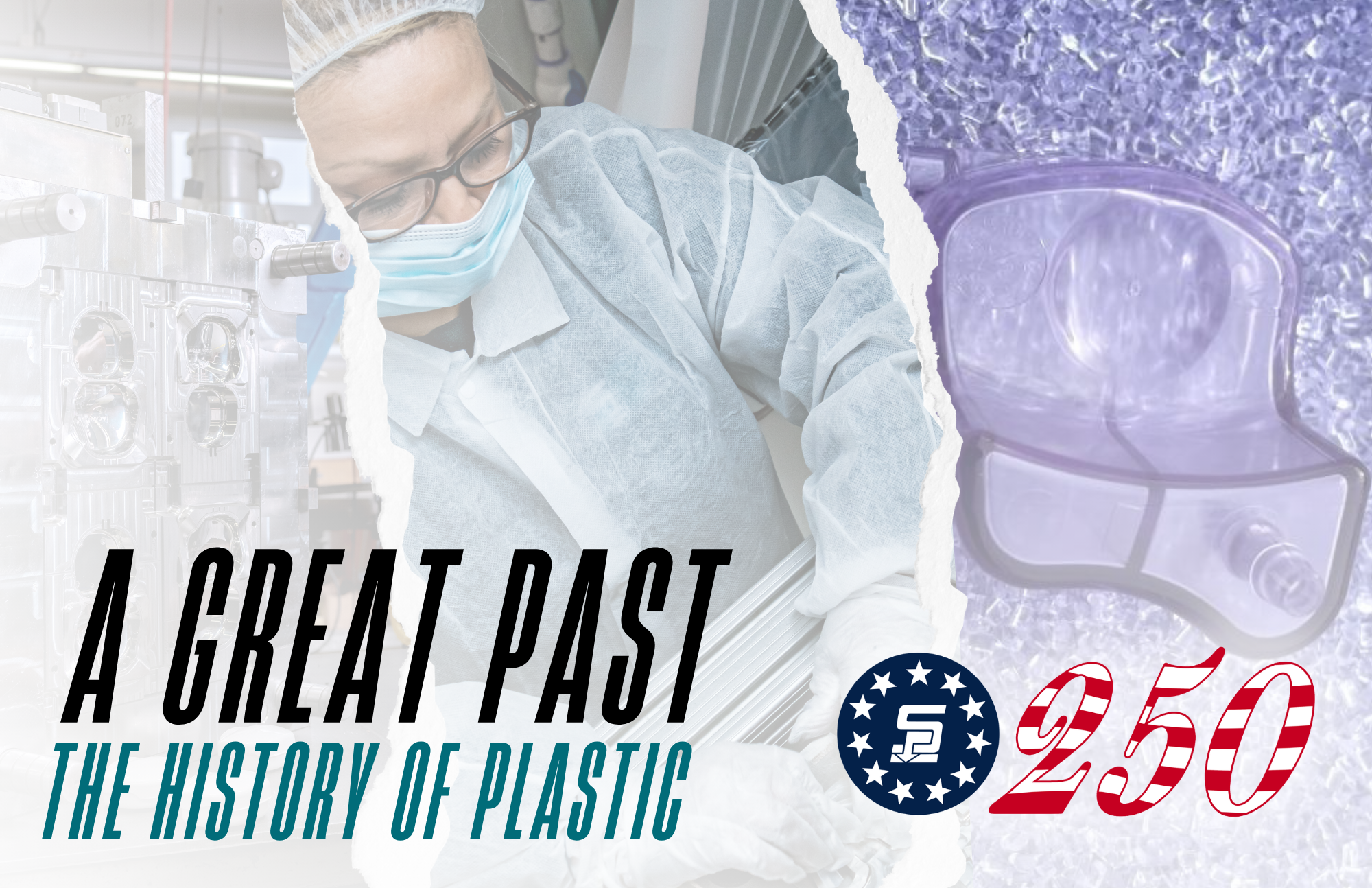
As the Summer of America 250 rolls on, Stelray continues its historical retrospective series with the history of plastics and injection molding. Last month brought you the colorful history of Stelray Plastics Products from its earliest days making hand tools in Shelton, Connecticut to the recent anniversary celebration in our expanded Ansonia plant. This month, we are going even further back to explore the materials and processes fundamental to our line of business.
An Elephant Always Remembers
The word “plastic” derives from the Greek word “plastikos”, meaning something that is pliable and easily formed or molded. Plastic, as we know it, is the common label for synthetic polymers—long chains of large, single-molecule monomers. There are many polymers that occur naturally, from cellulose to DNA, but they were neither fully identified nor understood until the turn of the Twentieth Century.
Despite this, in 1861 chemist Dr. Thomas Graham discovered a material he called “colloid” after attempting to dissolve cellulose through filter paper. This sticky, glue-like residue would go on to be studied and used by other chemists in the production of new materials. New York brothers John Wesley and Isaiah Hyatt would invent celluloid in 1870 while attempting to win a contest to develop a replacement for ivory in the manufacture of billiard balls. By mixing cellulose and camphor, then subjecting the mixture to great heat and pressure, the Hyatts discovered a semi-synthetic, semi-natural substance that became hard at ambient temperatures. This material would go on to be used in everything from piano keys to photography film and be heralded as the savior of the elephant. It was truly revolutionary.
Shellac to the Future
Forty years later, an even greater step in polymer science was made. In Yonkers, New York, scientist Leo Baekeland and his assistant Nathaniel Thurlow were hard at work researching a synthetic replacement for the scarce natural electrical insulator Shellac. Their initial efforts focused on creating a coating that would mimic Shellac but eventually pivoted to a standalone resin. Experimenting by impregnating pieces of wood with their concoction, Baekeland and Thurlow determined that subjecting a mixture of phenol and formaldehyde to heat and pressure would yield a solid material that was durable, heat-resistant, insulated well, and could be molded into almost any shape. Over the next twenty years, Baekeland would secure over 400 patents for the product he called Bakelite and began industrial manufacturing operations at a plant in New Jersey.
Throughout the 1930s and 1940s, the demands of World War II drove innovation across the world of synthetic polymers. The inventions of new materials like PVC, Nylon, and Plexiglas allowed manufacturers to overcome shortages of rubber and metal affecting industrial supply chains while also providing cheap, functional materials fit for many uses. In fact, plastic production only surged after the war ended with Americans using the post-war economic boom to expand their private consumption. Manufacturers met the market with this inexpensive, lightweight material capable of almost anything. Since the midcentury, scientists and industrial labs have introduced a variety of new materials from the highly durable polypropylene to the light-yet-strong High-Density Polyethylene. Polymer chemistry and the evolution of engineered plastic resins have continued to populate our world with high-performance alloys and compounds that challenge, and sometimes even exceed, the mechanical and physical properties of their ferrous or non-ferrous counterparts.
An Art & A Science
Molding itself is an ancient art, used as far back as the Stone Age to reproduce items subject to high demand or wear-and-tear. Popular examples include molds used to produce spearheads for hunting and military purposes, as well as molds to mass-produce coins. Molding for plastic was invented almost as fast as the material itself. Within years of introducing celluloid, the Hyatt brothers patented the first injection molding machine to mold their innovative substance. The machine was a simple plunger for pushing celluloid through a heated tube and into a mold for cooling and setting.
In 1946, James Watson Hendry introduced the first extrusion screw injection machine, which used a rotating screw to regulate the injection process for the production of more consistent molded parts. Hendry would also invent gas-assisted molding, which allowed for the manufacture of large, hollow parts in the injection molding process. Through this pair of industry-altering innovations by Hendry, plastics would continue to boom. By the 1970s, plastic production consumed a larger market share of manufacturing than steel—once the world’s most essential material.
Today, plastic injection molding is omnipresent, a fixture in nearly every manufacturing sector from Medical Devices to Consumer Electronics, Automotive Components, Housewares, and so much more. It remains one of the most cost-effective means of manufacturing at scale, combining durability, speed, reproducibility, and flexibility in a lightweight and safe material. As we look toward the future, the plastics industry sets its sights on more eco-friendly material solutions to improve industry sustainability, as well as strategic automation and more efficient machines to ensure plastic remains the most economical material on the market.
How Can I Learn More?
With centuries of combined experience building, maintaining, and reconditioning injection molds, Stelray is your preferred partner for getting the most out of your molded part program. If you want to learn more about our process, or are interested in a program consultation, please please call or email our Sales team below!
Sources:
American Chemical Society. (1993, November 9). Bakelite First Synthetic Plastic - National Historic Chemical Landmark. American Chemical Society. https://www.acs.org/education/whatischemistry/landmarks/bakelite.html
Science History Institute. (2025). History and Future of Plastics. Science History Institute. https://www.sciencehistory.org/education/classroom-activities/role-playing-games/case-of-plastics/history-and-future-of-plastics/
Technologies, S. (2021, July 13). A Brief History of Plastic Injection Molding. SyBridge Technologies. https://sybridge.com/a-brief-history-of-plastic-injection-molding/